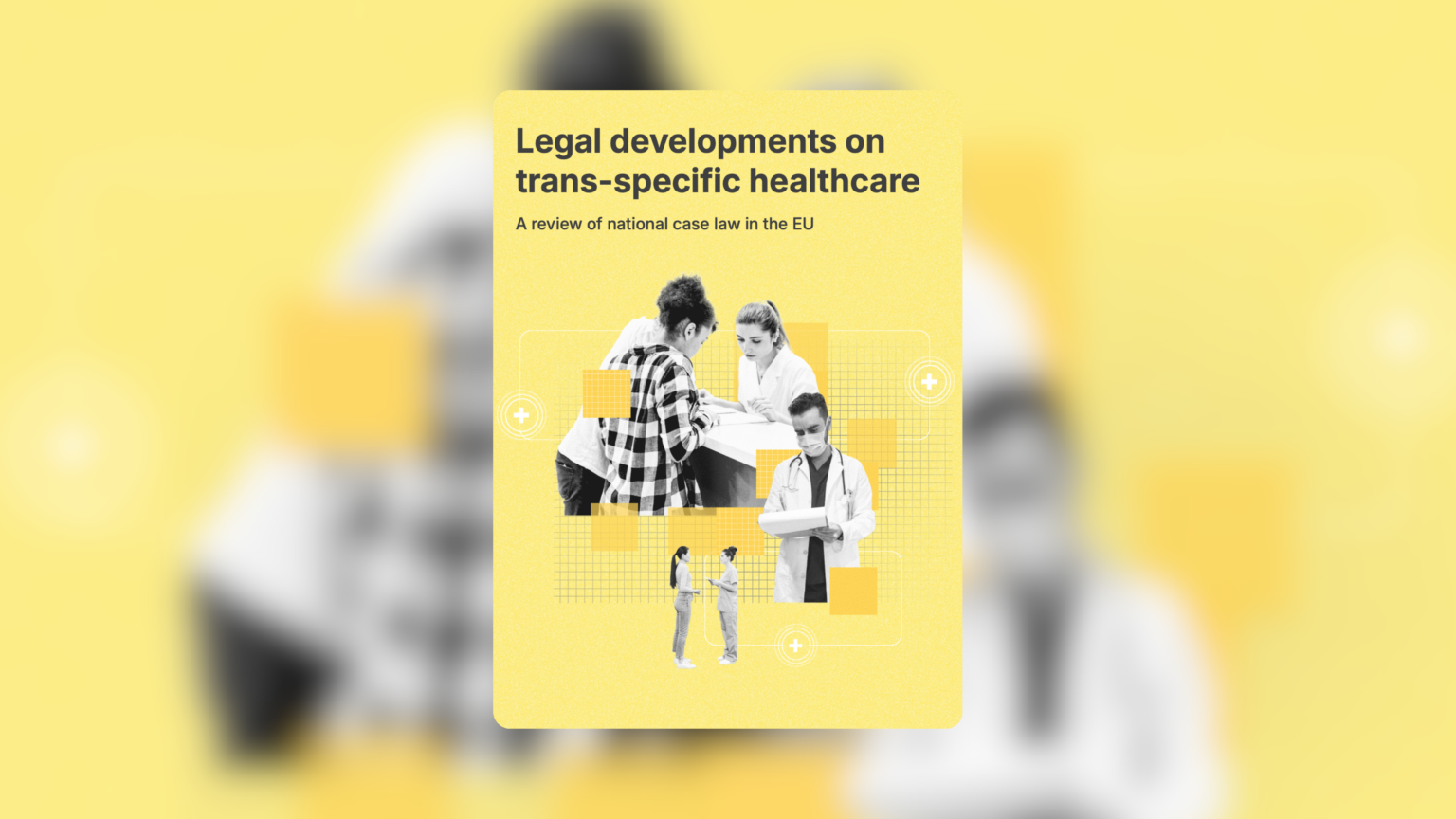
TGEU publishes Legal developments on trans-specific healthcare: A review of national case law in the EU
Court cases have been central to advancing the rights of trans people in Europe, but trans-specific healthcare remains largely untested in the courts.
Since the European Court of Human Rights’ earliest decisions on legal gender recognition, strategic litigation has driven many major advances. More recently, rulings by the Court of Justice of the European Union on freedom of movement and non-discrimination have further strengthened these gains. TGEU’s 2026 Trans Rights Map also found that national court decisions are increasingly driving progress in trans rights, particularly where legislative and policy advances are stalled or reversed.
Trans-specific healthcare is an exception and is comparatively less litigated at the European level. Trans people across the EU face significant barriers in accessing trans-specific healthcare. Enforcing their rights to healthcare is further complicated by administrative refusals, unclear national regulations, and national court rulings that remain largely unknown. At the same time, interest is growing in using legal tools to advocate for improved access to trans-specific healthcare, and in how courts across the region handle such cases.
Objective of the publication
This resource explains how litigation can help improve access to trans-specific healthcare by reviewing case law from national courts across EU Member States. Beyond resolving individual cases, court rulings can expand the scope of rights claims accepted and promote respectful, non-discriminatory language, even in complex areas like healthcare and health insurance law.
We hope this resource empowers activists and lawyers to explore legal tools to improve access to trans-specific healthcare, drawing on ideas and arguments from similar efforts across the region.
What the publication covers
The publication presents national court decisions from EU Member States and covers key topics such as cost coverage, travelling abroad for care, age limits, waiting times, and discrimination. It includes cases where trans applicants won and cases where they didn’t, so readers can see what aspects courts consider relevant to their decision. Although the publication reviews case law in nearly all Member States, relevant cases were found in only a handful of countries, including Austria, Belgium, Croatia, Denmark, France, Germany, Spain, and the Netherlands.
Your support makes change possible
We work across Europe and Central Asia to advance trans rights, build strong communities, and drive change through research, advocacy, and community-building.
Your donation helps us continue this vital work — defending trans lives, amplifying trans voices, and advocating for justice every day.

This project has been made possible in part by a grant from a fund of Silicon Valley Community Foundation.